
Bart Riemers wins Global Mind Assignment 1 with reflections from Washington, D.C
During their operational internship, students work on the Global Mind assignments, in which they reflect on cultural differences in their work and daily life. Bart Riemers was selected as the winner of Global Mind Assignment 1 thanks to his personal reflections. Below, you can read his experiences and observations from Washington, D.C.
Unusual ordinary things
Five first impressions of Washington, D.C.
In late July I swapped Maastricht for Washington, D.C., to start my Front Office internship at the Omni Shoreham Hotel in Woodley Park. These five photos capture small, everyday moments that stopped me in my tracks during my first two months: a chess game on a traffic island, deer beside a busy road, an avenue built for power, a stranger's kindness and a corner-store shelf. Each one surprised me, and more than once my first explanation turned out to be wrong.

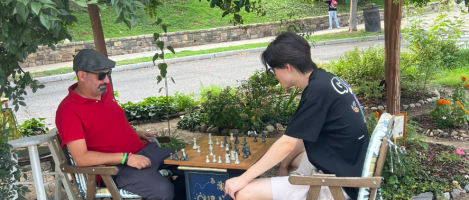
1. Checkmate, Stranger
Around the corner from my hotel, gardener and artist Patrick has turned a traffic island into "Our Garden", where he invites passers-by to pick the music and play chess. He does it, he told me, "to be free and hear stories from the world." In Maastricht most people might walk past; here his chairs are rarely empty, and through him I have met wonderful characters. Lewin's peach-and-coconut model helped me see this as openness at a different layer, not greater warmth. My curiosity, often called "un-Dutch" at home, fits here. My advice: take the empty chair.

2. The Statue That Blinked
Riding a Lime bike downtown along the traffic-heavy southern end of Rock Creek Park, I passed what I took for a deer statue, until it looked up at me. Ten meters away, neither buck ran. My colleagues just shrugged; to them, deer are as ordinary as squirrels. I assumed America simply had more space, but the National Park Service tells a different story: without predators, deer went from virtually absent before 1960 to nearly 100 per square mile, and have been culled every year since 2013. My advice: question your "obvious" explanation before sharing it.

3. A Street Built for Power
Standing on Pennsylvania Avenue on a rainy evening, I was struck by the space: a wide, empty avenue leading to the glowing Capitol. In the Netherlands every square meter goes to housing or shops, so my first thought was that America has room to spare. Wrong: Washington was planned this way in 1791, with grand avenues built to show off its government.
Dutch politicians work in the Binnenhof, a medieval courtyard you can stroll through. One familiar touch: cyclists get their own lane, just like home. My advice: pay extra attention to D.C.'s architecture and how it is built.

4. Juniper, Special Delivery
At Whole Foods I asked an employee for dried juniper berries for my homemade chicken-bone broth; he had never heard of them. A fellow shopper had. Hearing I was a Dutch intern, he told me to wait outside for fifteen minutes, went home and returned with his own unused jar. I struggle to picture this in the Netherlands.
Oddly, Hofstede ranks both our countries as highly individualistic. My guess: where the government does less, people step in for each other, and strangers become neighbors faster. My advice: ask for help out loud; many people here are happy to give it.

5. Same Shelf, Different Rules
At Manhattan Market, where I buy my cigarettes and chat with Daba, its Ethiopian owner, baby formula sits right beside a Marlboro cabinet topped with galloping cowboys. In the Netherlands, cigarettes hide behind closed doors in plain packs with shocking photos.
The US is stricter in one way: you must be 21 to buy tobacco, not 18. But as Daba told me, companies fight to keep cigarettes on display, and an age limit means little while they are marketed this actively. Graphic warnings have been stuck in court for years. My advice: look at who a rule protects, and why.
Looking Back: What these five moments taught me
My first explanation was often too quick. America did not simply have more space, and its people are not simply warmer. What taught me most was asking: Patrick at his chessboard, Daba behind his counter, my colleagues at the front desk and a stranger with a jar of juniper berries. That habit of asking before concluding is what I want to take into the rest of my internship, and back home to Maastricht.
Highlights
Bart Riemers wins Global Mind Assignment 1 with reflections from Washington, D.C
Bart Riemers was selected as the winner of Global Mind Assignment 1. Here, you can read his experiences in Washington, D.C.

Hotel Management School Maastricht is once again a Top-Rated Programme!
We are proud that our Bachelor programme has been awarded the prestigious Top-Rated Programme quality label in 2027.
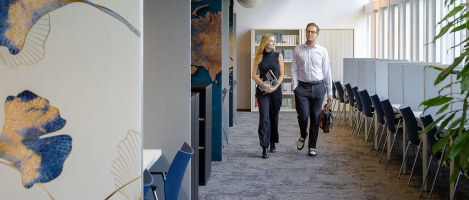
Introducing: The Commons, study & coworking area
A place where students and lecturers can meet, collaborate, and work both individually and in groups.