
Let's catch up with Roelof ten Cate
[F 2020]
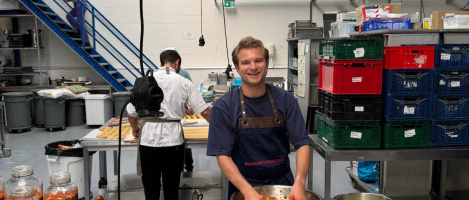
For many students at Hotel Management School Maastricht, entrepreneurship is something for the future. For alumnus Roelof ten Cate [F 2020], that future came much sooner. Together with his business partner, he now runs Kimchi Cure, a start-up specialised in traditional, unpasteurised kimchi. What started as an entrepreneurial ambition during his time at the hotel school has grown into a company with a clear mission: pure fermentation, without compromising on quality.

An entrepreneurial mindset from Hotel Management School Maastricht
Roelof graduated from Hotel Management School Maastricht in 2020. During his studies, he was already working on concepts and business plans, experience that later proved to be very valuable. According to him, the entrepreneurial spirit was always there.
After graduating, Roelof started working in a corporate environment, but he soon realised that the work did not give him enough energy. Creativity and dynamics were far more important to him than working behind a screen. During the COVID-19 period, he moved into growth marketing, where he developed skills in online marketing, advertising, and digital strategy. Eventually, he decided to quit his permanent job and start freelancing: a step that truly put him into an entrepreneurial mindset.
Kimchi Cure
Through his current business partner, Willem Schrader, Roelof became involved with Kimchi Cure. The concept already existed in an early stage, but together they decided to further develop the brand. For Roelof, everything came together: entrepreneurship, creativity, and his passion for food.
At Kimchi Cure, everything revolves around traditional fermentation. The kimchi is made in an authentic way, without pasteurisation. This ensures that the natural probiotics and lactic acid bacteria remain intact. According to Roelof, this strongly differentiates the company from many supermarket products.
The ambition of Kimchi Cure is to become the market leader in traditional kimchi in the Netherlands and to expand the range in the future with other fermented products. In addition, they aim to work more closely with artisanal shops, delicatessens, and hospitality businesses throughout the country that share the same vision on quality and purity.

“At Hotel Management School Maastricht, you constantly learn to look for solutions. I apply that every single day in my company.”


Working in a start-up: doing everything at once
Within Kimchi Cure, the two partners have divided their roles based on their strengths. While his partner mainly focuses on sales and production, Roelof is responsible for marketing, branding, finance, and digitalisation. From building websites and creating content to AI automation and CRM systems—entrepreneurship involves a bit of everything.
“You move from being a specialist to someone who has to know a little bit about everything.”
In addition, Kimchi Cure consciously works with people who have a distance to the labour market, something Roelof describes as both challenging and highly valuable.
What do you take from Hotel Management School Maastricht?
According to Roelof, it is not only the theoretical models or business plans that prove useful, but especially the way of thinking you develop at Hotel Management School Maastricht.
One important lesson he applies every day is solution-oriented thinking: constantly looking for possibilities, improvements, and new opportunities. He also still benefits from the broad business knowledge and hospitality mindset he gained at Hotel Management School Maastricht, from being customer-focused and building relationships to taking initiative and connecting different parts of an organisation.
"At Hotel Management School Maastricht, you constantly learn to look for solutions. I apply that every single day in my company."

The most important advice for students
For current students and recent graduates who want to start their own start-up, Roelof has a clear message: make use of the alumni network. According to him, you learn the most from people who have already walked the same path. Simply reaching out to alumni or entrepreneurs can be extremely valuable.
Conclusion
Roelof’s story shows that entrepreneurship does not always start with a fully developed plan. Sometimes it grows through new experiences, unexpected opportunities, and simply taking the first step.
Kimchi Cure hopes to enter into more collaborations with artisanal shops, delicatessens, hospitality entrepreneurs, and other entrepreneurs within the alumni network. Do you know a place where Kimchi Cure would be a good fit, or are you interested in a collaboration? The team is always open to new connections.
Highlights

Let's catch up with Isa Flaskamp [F 2022]
From hotelschool to the Unilever Future Leaders Programme: Isa Flaskamp [F 2022] shares her story.


Just graduated: Juliëtte van der Ham [F 2026]
Discover how Juliette van der Ham [F 2026] found her way into hotel real estate.
Let's catch up with Roelof ten Cate [F 2020]
Read how alumnus Roelof [F 2020] turned his passion for food into a business.